
广告位联系
返回顶部
分享到

PostgreSQL图(graph)的递归查询

数据库其他 来源:互联网搜集 作者:秩名 发布时间:2020-04-17 21:05:42 人浏览
摘要

背景 在树形递归查询这篇文章,我记录了使用CTE语法查询树形结构的办法。在一个树形结构中,每一个节点最多有一个上级,可以有任意个数的下级。 在实际场景中,我们还会遇到对图(graph)的查询,图和树的最大区别是,图的节点可以有任意个数的上级和下级。如

背景

在树形递归查询这篇文章,我记录了使用CTE语法查询树形结构的办法。在一个树形结构中,每一个节点最多有一个上级,可以有任意个数的下级。

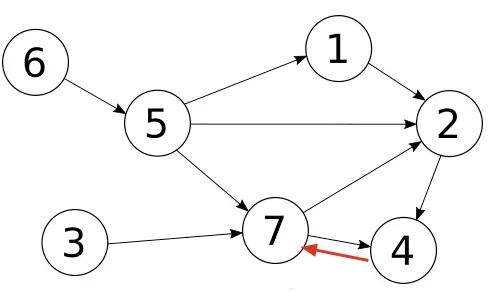
在实际场景中,我们还会遇到对图(graph)的查询,图和树的最大区别是,图的节点可以有任意个数的上级和下级。如下图所示

因为图可能存在loop结构(上图红色箭头),所以在使用CTE递归的过程中,必须要破环(break loop),否则算法就会进入无限递归,永不结束。

存储和查询图结构,目前当红数据库是neo4j,但是当数据量只有十几万条的时候,PostgreSQL完全可以胜任。

构造样本数据

?
1
2
3
4
5
6
7
8
9
10
11
12
-- 每一条有向关系边都存在上游,下游两个节点
drop table if exists demo.t_rel;
create table if not exists demo.t_rel(up int , down int);
 
-- 唯一约束,避免插入相同的关系
alter table demo.t_rel add constraint udx_t_rel unique (up, down);
 
insert into demo.t_rel values(6,5),(3,7),(5,1),(1,2),(5,2),(5,7),(7,2),(2,4),(7,4);
 
-- 构造一条环数据,7-2-4-7
delete from demo.t_rel where up=4 and down=7;
insert into demo.t_rel values(4,7);
 

递归查询

指定节点的下级

常见的一个场景是,给定一个节点,查询这个节点的所有下级节点和路径。使用破环的算法关键如下

  • 使用数组保存当前的路径信息。
  • 计算下一个节点之前,判断该节点是否已经存在于路径上。如果是,就说明该点是环的起点,必须排除这个节点来达到破环的效果。
  • 起始节点和最大深度,都是可选的。如果忽略这两个条件,就会返回完整的图信息。
?
1
2
3
4
5
6
7
8
9
10
11
12
13
14
15
16
17
with recursive
downstream as
(
    select 1 as lvl, r.up, r.down,
            -- 保存当前路径
            array[]::int[] || r.up || r.down as trace
        from demo.t_rel r 
    where r.up = 7 -- 指定起点
    union all
    select ds.lvl +1, r.up, r.down, ds.trace || r.down
        from demo.t_rel r , downstream ds
    where r.up = ds.down
        -- 破环
        and not r.down = any(ds.trace)
        and ds.lvl < 20 -- 最大深度
)
select * from downstream ds;
 

上面以节点7为开始,返回下级的所有节点和路径信息,如下。

?
1
2
3
4
5
6
7
-- 可以看到并没有包括7-2-4-7这条环。
 lvl | up | down | trace
-----+----+------+---------
 1 | 7 | 2 | {7,2}
 1 | 7 | 4 | {7,4}
 2 | 2 | 4 | {7,2,4}
(3 rows)
 

指定节点的所有关联

在社交网络的场景中,我们根据一个特定的节点,查询所有的关系网。在本文的样本数据中,我们的需求就变成,同时查询指定节点的所有上级和下级。

为了方便后面的测试,我们封装一个函数

?
1
2
3
4
5
6
7
8
9
10
11
12
13
14
15
16
17
18
19
20
21
22
23
24
25
26
27
28
29
30
31
32
33
34
35
36
37
38
39
40
41
42
43
44
45
46
47
48
49
drop function if exists f_get_rel;
 
/*
取得某个节点的相关联节点,和路径信息。
@start_node 起始节点。
@direct_flag 查询方向,-1:查找上级;1:查找下级; 0:查找上下级;
@max_depth 递归深度,即查找最多几级关系。
*/
create or replace function f_get_rel(start_node int, direct_flag int=1, max_depth int=20)
    returns table (direct int, cur_depth int, up_node int, down_node int, trace int[])
as $$
begin
 
    return query
        with recursive
        downstream as
        (
            select 1 as lvl, r.up, r.down, array[]::int[] || r.up || r.down as trace
                from demo.t_rel r
            where r.up = start_node
                and direct_flag in (0, 1)
            union all
            select ds.lvl +1, r.up, r.down, ds.trace || r.down
                from demo.t_rel r , downstream ds
            where r.up = ds.down
                and not r.down = any(ds.trace)
                and ds.lvl < max_depth
        ),
        upstream as
        (
            select 1 as lvl, r.up, r.down, array[]::int[] || r.up || r.down as trace
                from demo.t_rel r
            where r.down = start_node
                and direct_flag in (0, -1)
            union all
            select us.lvl +1, r.up, r.down, r.up || us.trace
                from demo.t_rel r , upstream us
            where r.down = us.up
                and not r.up = any(us.trace)
                and us.lvl < max_depth
        )
        select -1, us.* from upstream us
            union all
        select 1, ds.* from downstream ds
        order by 1 desc, lvl, up, down
    ;
 
end;
$$ language plpgsql strict;
 

测试一下,查询节点7的所有3度关联节点信息,如下

?
1
2
3
4
5
6
7
8
9
10
11
12
13
14
dap=# select * from demo.f_get_rel(7,0,3);
 direct | cur_depth | up_node | down_node | trace
--------+-----------+---------+-----------+-----------
  1 |   1 |  7 |   2 | {7,2}
  1 |   1 |  7 |   4 | {7,4}
  1 |   2 |  2 |   4 | {7,2,4}
  -1 |   1 |  3 |   7 | {3,7}
  -1 |   1 |  4 |   7 | {4,7}
  -1 |   1 |  5 |   7 | {5,7}
  -1 |   2 |  2 |   4 | {2,4,7}
  -1 |   2 |  6 |   5 | {6,5,7}
  -1 |   3 |  1 |   2 | {1,2,4,7}
  -1 |   3 |  5 |   2 | {5,2,4,7}
(10 rows)
 

图形显示结果

ECharts模板

在没有集成图形界面之前,使用ECharts的示例代码(地址),可以直观的查看关系图谱。对官方样表进行微调之后,代码如下
注意 代码中的 data 和 links 部分需要进行替换

?
1
2
3
4
5
6
7
8
9
10
11
12
13
14
15
16
17
18
19
20
21
22
23
24
25
26
27
28
29
30
31
32
33
34
35
36
37
38
39
40
41
option = {
 title: {
  text: '数据图谱'
 },
 tooltip: {},
 animationDurationUpdate: 1500,
 animationEasingUpdate: 'quinticInOut',
 series : [
  {
   type: 'graph',
   layout: 'force',
   force: {
     repulsion: 1000
    },
   focusNodeAdjacency: true,
   symbolSize: 30,
   roam: true,
   label: {
    normal: {
     show: true
    }
   },
   edgeSymbol: ['circle', 'arrow'],
   edgeSymbolSize: [4, 10],
   edgeLabel: {
    normal: {
     textStyle: {
      fontSize: 20
     }
    }
   },
   data: [
    { name:"2", draggable: true, symbolSize:20},
   ],
   links: [
    { source:"2", target:"4"},
   ],
 
  }
 ]
};
 

造显示用数据

构造 data 部分

?
1
2
3
4
5
6
7
8
9
-- 根据节点的关联点数量,设置图形大小
with rel as (select * from f_get_rel(7,0,2)),
    up_nodes as (select up_node, count(distinct down_node) as out_cnt from rel group by up_node),
    down_nodes as (select down_node, count(distinct up_node) as in_cnt from rel group by down_node),
    node_cnt as ( select up_node as node, out_cnt as cnt from up_nodes union all select * from down_nodes )
select '{ name:"' || n.node || '", draggable: true, symbolSize:' || sum(n.cnt) * 10 || '},' as node
    from node_cnt n
group by n.node
order by 1;
 

构造 links 部分

?
1
2
3
select distinct r.up_node, r.down_node, '{ source:"'|| r.up_node ||'", target:"'|| r.down_node ||'"},' as links
    from f_get_rel(7,0,3) r
order by r.up_node  ;
 

图形显示

把构造的data和links替换到ECharts代码里面

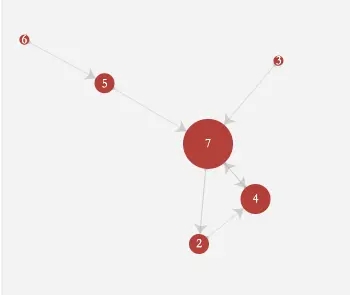
查询节点7的所有2度关联节点信息,结果显示如下

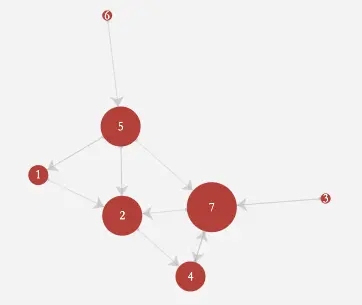
查询节点7的所有关联节点信息(不限层级数),结果显示如下


版权声明 : 本文内容来源于互联网或用户自行发布贡献,该文观点仅代表原作者本人。本站仅提供信息存储空间服务和不拥有所有权,不承担相关法律责任。如发现本站有涉嫌抄袭侵权, 违法违规的内容, 请发送邮件至2530232025#qq.cn(#换@)举报,一经查实,本站将立刻删除。
原文链接 : https://juejin.im/post/5ddfb9b1518825434771d0fc
相关文章
  • 六大主流数据同步工具对比:DataX、Airbyte、Cana
    当数据量变大、数据源复杂、实时需求提高,很多团队在选数据同步工具时犯难。本文对 DataX、Airbyte、Canal、Debezium、Fivetran 与 Apache SeaTun
  • 解读SQL生成工具
    SQL 生成工具可用于测试Parser与其他数据库产品的兼容性,通过解析YACC语法文件中的产生式,生成对应的SQL语句,再使用数据库执行该SQL,根
  • SQLite3在嵌入式C环境中存储音频/视频文件的最优

    SQLite3在嵌入式C环境中存储音频/视频文件的最优
    SQLite3 在嵌入式C环境中存储音频/视频文件的专业方案 在嵌入式系统中存储大型媒体文件需要平衡存储效率、访问速度和资源限制。以下是针
  • 嵌入式数据库SQLite 3配置使用

    嵌入式数据库SQLite 3配置使用
    0、惨痛教训 随着管理开发的项目体积越来越庞大,产品系统涉及的数据量也越来越多,并且伴随着项目不久就要交付给甲方了。如果项目的
  • Sqlite3基本语句及安装过程

    Sqlite3基本语句及安装过程
    SQLite3简介 SQLite3是一款轻量级的、基于文件的开源关系型数据库引擎,由 D. Richard Hipp 于 2000 年首次发布。它遵循 SQL 标准,但与传统的数据
  • 在SQLite中进行批量操作的有效实现方法
    SQLite 是一个轻量级的关系型数据库管理系统,因其高效性和易用性而广受欢迎。在许多应用场景中,批量操作的需求是不可避免的,例如在
  • 一文介绍在Hive中NULL的理解
    在 Hive 中,NULL 是一个特殊的值,表示未知或缺失。任何与NULL的比较操作(如=,,,=,=,)都会返回NULL,而不是TRUE或FALSE。 1.NULL 的比较规则 在
  • Navicat Premium 12数据库管理解决方案

    Navicat Premium 12数据库管理解决方案
    Navicat Premium 12是一款全面的数据库管理工具,支持多种数据库系统如MySQL、MariaDB、Oracle、SQL Server、PostgreSQL等。它提供了多数据库连接、数据
  • sqlite3命令行工具使用介绍
    一、启动与退出 启动数据库连接 1 2 3 sqlite3 [database_file] # 打开/创建数据库文件(如 test.db) sqlite3 # 启动临时内存数据库 (:memory:) sqlite3 :m
  • StarRocks简介与搭建使用介绍

    StarRocks简介与搭建使用介绍
    StarRocks简介 StarRocks 是一款高速、实时、全场景的MPP(大规模并行处理)分析型数据库系统,专为现代数据分析场景设计,强调亚秒级查询性
  • 本站所有内容来源于互联网或用户自行发布,本站仅提供信息存储空间服务,不拥有版权,不承担法律责任。如有侵犯您的权益,请您联系站长处理!
  • Copyright © 2017-2022 F11.CN All Rights Reserved. F11站长开发者网 版权所有 | 苏ICP备2022031554号-1 | 51LA统计